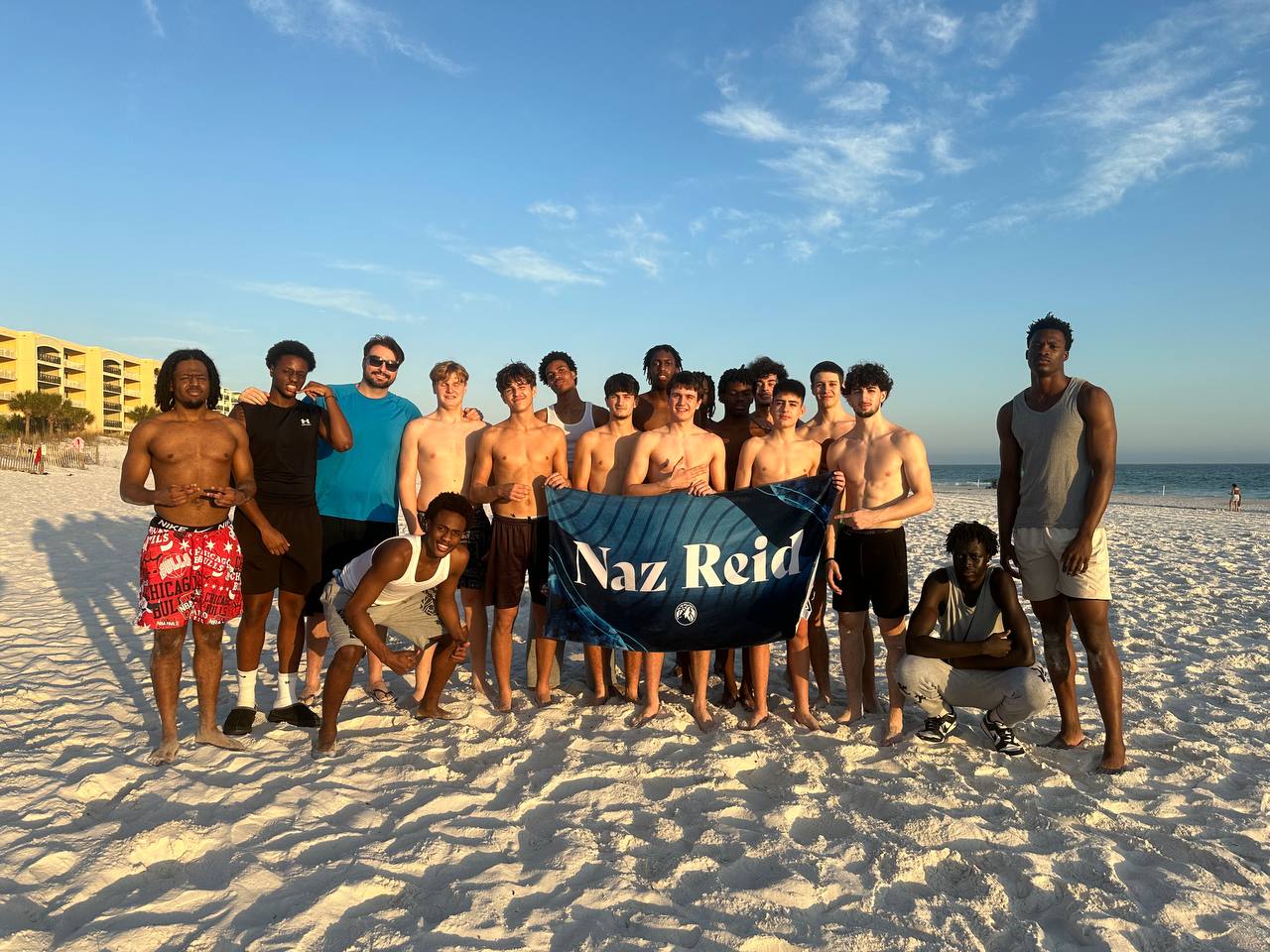
Best Basketball Prep School in Fort Walton Beach, FL
If your son is serious about D1 basketball, the prep school decision might be the most important choice you make. And if you’ve never considered Fort Walton Beach, Florida — you’ve been overlooking one of the best-kept secrets in elite basketball development.
This post breaks down exactly what separates a great basketball prep school from an average one, why the Florida Panhandle offers training advantages that programs in major metro areas can’t match, and what families should actually look for before writing a six-figure check.
What Makes a Basketball Prep School “Elite”
The word “elite” gets used so loosely in youth basketball it’s almost meaningless. Every AAU team is elite. Every camp is elite. Every recruiting service promises elite exposure.
Here’s the reality: fewer than 1% of high school basketball players earn a Division I scholarship. The programs that actually move that needle share a handful of characteristics — and none of them are the things most families spend time evaluating.
Coaching pedigree beats facility photos every time. A beautiful gym doesn’t make a player better. Coaches who have played at the highest levels, who understand what D1 programs want, and who have direct relationships with college coaches — that’s what changes trajectories.
At Florida Coastal Prep, our training model includes access to The Grind Session — an exclusive ongoing basketball league where FCP athletes compete alongside and against former NBA Draft Picks. There’s no simulation for what it feels like to guard someone who spent time in the league. That competitive exposure changes how players see the game, and it changes what they think they’re capable of.
Academic infrastructure matters more than parents think. Every college coach you want your son to play for will ask about grades before they ask about vertical. Programs that treat academics as an afterthought are not programs that produce D1 athletes at scale. They’re programs that produce players who run out of eligibility.
The training environment is the curriculum. Daily exposure to elite competition — not occasional showcases — is what develops players. The question to ask any prep school is: what does a normal Tuesday look like? If the answer involves watching film, getting individual position coaching, and being pushed in a structured practice environment, that’s signal. If the answer is vague, that’s also signal.
Why Fort Walton Beach Is a Hidden Gem for Basketball Development
There’s a reason top basketball programs have historically concentrated in South Florida and central Florida. Talent density, weather, visibility. Those things matter.
But here’s what families don’t see until they’ve been through the process: those same factors — especially density and visibility — create noise. Hundreds of players chasing the same limited spots. Programs competing for attention rather than results.
Fort Walton Beach and the broader Florida Panhandle offer something different.
World-class indoor training, without the distractions. FCP’s Spartan Training Center is a 14,000 sq ft indoor facility built to professional standards — NBA-dimension hardwood (94×50 ft), shot clocks, a video board, two Shoot-Away shooting guns, a 60 ft turf training zone, and 24/7 availability. Players here aren’t scraping for court time or dealing with competing programs in the same gym. When the facility is yours around the clock, the only limit on development is the player’s own work ethic.
The military community builds a specific kind of athlete. Fort Walton Beach sits adjacent to Eglin Air Force Base and Hurlburt Field — two of the largest military installations in the country. This community produces young people with discipline, resilience, and a culture of doing what’s required without waiting to feel motivated. That environment is contagious. Players who train alongside military kids develop habits that soft environments don’t produce.
Less exposure noise means more genuine development. When a program isn’t running 40 players through the gym trying to justify marketing spend, coaches can actually coach. At FCP, the player-to-coach ratio reflects our commitment to individual development. Your son isn’t a body in a showcase. He’s a project.
The 5 Questions Every Family Should Ask Before Choosing a Prep School
Before you evaluate any basketball prep school — in Fort Walton Beach or anywhere else — ask these five questions and pay attention to how the program answers them.
1. What is your D1 placement rate, and can you document it?
Not “how many players have we sent to college.” Specifically, D1 programs, with names and years. Any program worth its tuition will have this information readily available. If they pivot to highlight stories rather than data, pivot away from them.
At FCP, we can point to named placements: Sean East (NBA G-League / Missouri Tigers), Brandon Maclin (DePaul), Kylin Green (Houston Baptist), Ring Malith (SIU Edwardsville) — under Coach DeForest’s direction alone.
2. What does daily practice look like?
Ask for a schedule. Real programs have structure. If a school can’t describe a typical Tuesday practice — who’s coaching, what’s being worked on, how long, what’s the competitive format — that tells you everything.
3. How does your academic support work, and what’s your eligibility clearance record?
NCAA eligibility requires a specific GPA in specific core courses. Ask how many of their players have been cleared by the NCAA Eligibility Center. Ask what percentage of their graduating class meets Division I academic requirements. The answer to this question separates programs from training facilities.
4. Who are your coaches, and what is their playing background?
Coaching credentials matter, but playing experience at the highest level matters differently. A coach who has sat across from a college scout, who has walked into an NBA practice, who has made the roster cut — that coach can tell your son what it actually takes in a way that changes behavior, not just awareness.
At FCP, our coaching staff includes men who have competed professionally and at the D1 level. Skills Development Director Kenny Anderson — 1991 second overall NBA Draft pick, 14-year NBA career, 1994 All-Star — works directly with our players. The Grind Session connects FCP athletes with former NBA Draft Picks as competitive opponents in a real league setting. That’s not a marketing claim. It’s a program design decision.
5. What happens if my son isn’t progressing?
This is the question nobody asks. Great programs have honest conversations when things aren’t working. They adjust. They have the hard conversation. If a school gives you a vague answer about their development philosophy but can’t describe a process for identifying and addressing individual weaknesses, they’re running a camp with a curriculum wrapper, not a development program.
What Families Who’ve Been Through This Say
Paul Biancardi, ESPN Recruiting Director, has been to our facility. His response: “Love your program! First class treatment of players and you are pushing them to be their best!”
That’s not a testimonial we manufactured. That’s someone who has seen hundreds of prep programs giving an honest reaction.
Parents who’ve had sons go through FCP echo the same themes. Sean East Sr., whose son Sean East went on to earn a D1 scholarship and now competes in the NBA G-League: “Coach Lee DeForest was instrumental in putting my son in the position to compete against high level competition as well as in front of college coaches. My son matured and received a D1 scholarship.”
Shawn Roy, another FCP parent: “My son had zero offers coming out high school, and after completing his time at FCP, he had plenty of offers.”
You can read more on our testimonials page.
What Sets Florida Coastal Prep Apart
Florida Coastal Prep was built on a specific premise: the gap between high-level high school basketball and Division I college basketball is not primarily physical. It’s experiential.
Players who make the transition successfully have been in high-pressure situations, have played against elite competition consistently, have been coached with precision, and have academic profiles that keep options open. Programs that produce D1 athletes build those four things systematically, not occasionally.
Our Fort Walton Beach location gives players access to the 14,000 sq ft Spartan Training Center, a military-influenced culture of excellence, and a lower-noise environment where development — not exposure — is the primary output.
The Grind Session puts FCP players on the court competing in a real league against former NBA Draft Picks and other elite competition. That’s the highest level of game-speed challenge available to prep players anywhere in the country.
Our academic program ensures players build the eligibility profile that keeps every door open. Our post-graduate program gives late developers and transfer athletes a structured bridge year to the college game.
Is Fort Walton Beach the Right Fit for Your Son?
The honest answer is: it depends on what your son needs.
If he needs more exposure events and to be around as many D1 coaches as possible, there are Florida programs better positioned for that. We’ll tell you that directly.
If he needs to be in an environment where the competition is real, the coaching is deep, the academics are serious, and the culture is built around daily discipline — Fort Walton Beach and the Florida Panhandle offer something distinctive.
The families who choose FCP tend to know the difference between hype and substance. They’ve done the research. They’ve visited programs that looked impressive and felt hollow. They want a place that’s going to develop their son, not showcase him.
If that’s what you’re looking for, we’d like to talk.
Ready to learn more about Florida Coastal Prep? Schedule a visit or reach out to our recruiting staff. We’ll give you a direct answer to every question on this list — and a few you haven’t thought to ask yet.
Ready to take the next step? Apply to Florida Coastal Prep.
Looking for college basketball programs? Browse our directory of 1,900+ programs across D1, D2, D3, NAIA, and JUCO — with coach contacts and recruiting info.