DME Academy vs Florida Coastal Prep — Which Is Better?
Every year, families researching prep basketball programs in Florida compare the same two names: DME Academy and Florida Coastal Prep. Both are based in Florida. Both produce college athletes. That is where the similarities end.
The programs differ fundamentally in coaching pedigree, roster size, development philosophy, and what a family actually gets for their investment. This post walks through both programs point by point — so you can evaluate based on substance rather than name recognition alone.
We have an obvious stake in this — FCP is our program. The families who thrive here are the ones who chose us because we were the right fit, after doing the research. So let’s do it together.
Quick Overview: DME Academy vs Florida Coastal Prep
| DME Academy | Florida Coastal Prep | |
|---|---|---|
| Location | Daytona Beach, FL | Fort Walton Beach, FL (Emerald Coast) |
| Program Types | High School & Post Grad | High School Prep & Post Grad |
| Setting | Large metro, I-95 corridor | Mid-size Gulf Coast city |
| Leagues | National competition schedule | National competition schedule |
| Key Differentiator | Large program, less individual attention | NBA All-Star coaching, small roster, proven D1 placements |
| Academic Partner | On-site school | Colorado Christian University partnership |
| International Reach | Strong | 22 countries, 43 states |
Coaching Staff Comparison
This is where the two programs diverge most sharply — and it matters more than most families initially realize.
DME Academy has a coaching staff built around prep and collegiate coaches. They have produced college athletes over the years and operate a large program infrastructure.
Florida Coastal Prep is built around Kenny Anderson, a 14-year NBA veteran who was the second overall pick in the 1991 NBA Draft, an NBA All-Star, and one of the most decorated point guards of his generation. Anderson played alongside and against the best players in the world for over a decade. He has been coaching at the prep and college level for years, and his recruiting relationships inside college basketball — from assistants to head coaches — are the kind that only come from a career at the highest level.
What does that actually mean for a player?
It means when a D1 assistant watches film of your player and sees Kenny Anderson’s name attached to their program, they pick up the phone. It means your son or daughter is receiving coaching from someone who has been in the exact situations they are working toward — NBA Finals pressure, All-Star competitions, high-stakes playoff environments. The gap between knowing basketball well and having lived it at the highest level is measurable, and it shows up in how Anderson teaches footwork, reads, and decision-making under pressure.
The rest of the FCP staff rounds out the picture: Director Lee DeForest brings years of program-building experience, and coaches Tyler Martin, Vando Becheli, and Rico Overall bring a combination of playing experience and development expertise. It is a tight, cohesive staff — not a rotating door of part-time coaches.
College Placement Records
Both programs will point to strong college placement numbers, and both deserve credit for producing college athletes. This section is not about dismissing DME’s results — it is about understanding what the numbers mean.
Florida Coastal Prep has recorded 59+ college placements since 2024, spanning Division I, Division II, NAIA, and JUCO programs. Notable alumni include:
- Sean East II — Went from FCP through Missouri and is now in the NBA
- Nathan Mariano — Reached the NBA, currently with the Phoenix Suns organization
- Ring Malith — Signed with SIU Edwardsville as a D1 player
Those are real outcomes at the highest levels of the sport.
But raw placement numbers only tell part of the story. The more important question is: how does the program get athletes placed?
At FCP, every athlete enters with an individualized recruiting plan. The coaching staff actively contacts college programs, produces professional-grade film, and maintains relationships with coaches at every level. Because roster sizes are intentionally kept smaller, no player is an afterthought. The staff knows every player’s timeline, target schools, and eligibility situation personally.
Larger programs — and DME runs a larger operation — can generate strong aggregate placement numbers while some players receive less individual attention simply due to volume. That is not a criticism of DME’s intentions; it is a structural reality of scale. If a player needs to be advocated for aggressively — not just placed in the right environment and left to produce — a smaller program’s model often delivers better outcomes.
For families who want to verify the track record, FCP’s college commitments page documents placements with school and level.
Facilities and Training Environment
DME Academy operates out of a dedicated campus facility in Daytona Beach with courts, weight rooms, and housing on or near campus. For many years, they have invested in the physical infrastructure of prep basketball.
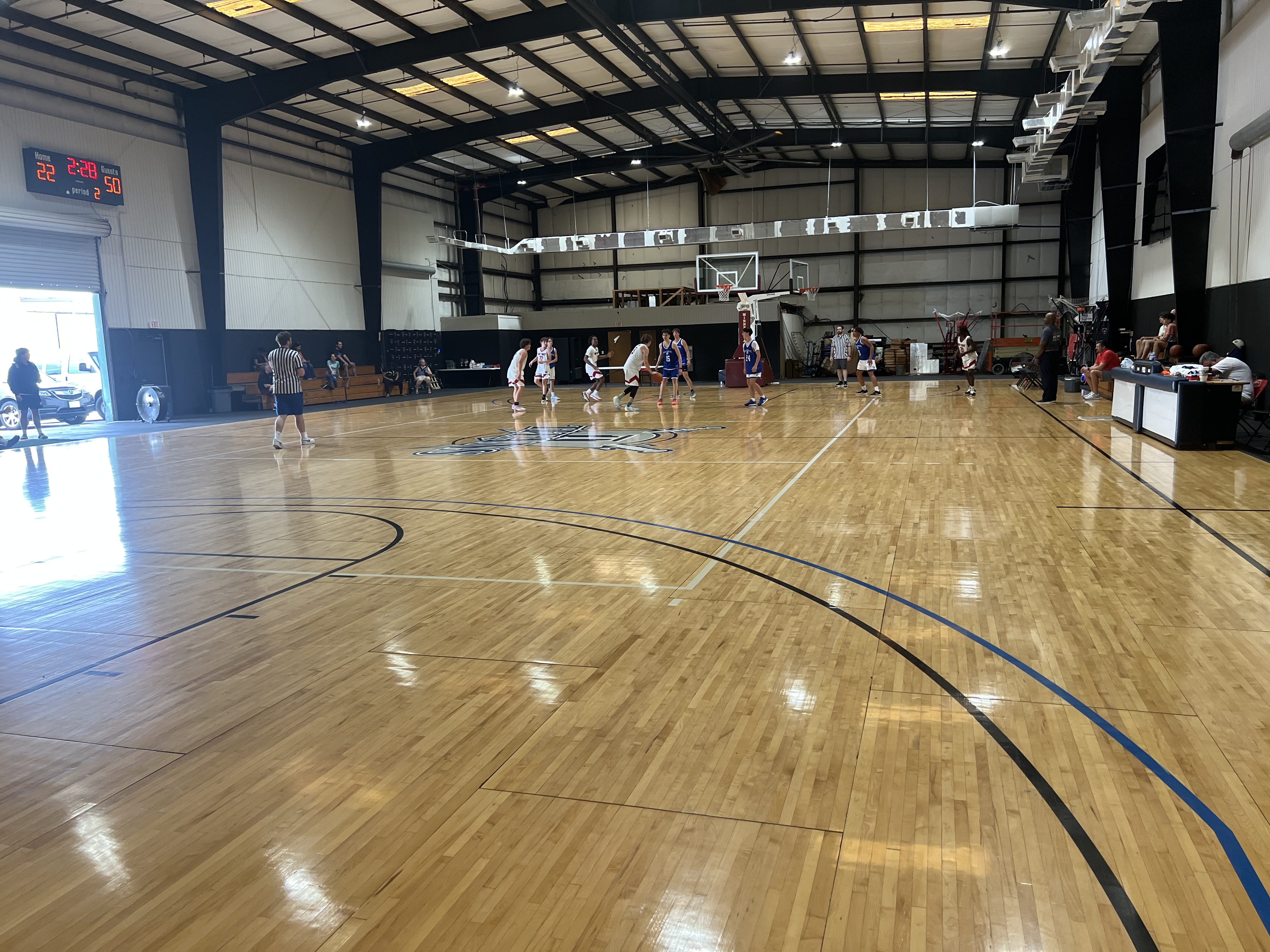
Florida Coastal Prep trains out of the Spartan Training Center, a 14,000 square foot dedicated basketball facility in Fort Walton Beach. The Spartan Center includes:
- Full-length hardwood courts built for elite play
- A dedicated film room for tactical review and recruiting film production
- A comprehensive weight room for strength and conditioning
- Indoor turf area for footwork and agility work
The Spartan Training Center was built specifically for the type of intensive, film-integrated development that FCP emphasizes. Film sessions are not optional extras bolted onto practice — they are woven into the training week. Players learn to see the game the way coaches see it, which accelerates both on-court development and the kind of self-awareness that impresses college coaches during visits and interviews.
For post-grad players in particular, the training environment is a significant factor. You are not competing for court time against a massive roster. You are getting real reps, real coaching attention, and real film — every session.
Academic Programs
Academics at FCP are structured around one central goal: keeping players eligible and getting them accepted to college programs.
Florida Coastal Prep has a formal academic partnership with Colorado Christian University, which provides accredited coursework, NCAA eligibility support, and college application preparation. This matters enormously for two groups of players:
Post-grad athletes who need a final year to rebuild their academic eligibility, raise GPA, or retake standardized tests before college enrollment. The FCP academic model is specifically designed to move these numbers in the right direction within a single year.
International players who are navigating U.S. academic requirements for the first time. With athletes from 22 countries, FCP has built real infrastructure for international eligibility management — including the paperwork, course equivalencies, and NCAA/NAIA clearinghouse processes that trip up international families working with programs that don’t have this experience.
DME Academy also provides academic support on-site through a school structure. For players who need a more traditional classroom environment or a full multi-year academic program, that model may be a better fit.
The key question for any family evaluating academics at a prep program: what happens if my son or daughter is still not eligible when the program ends? Ask both programs that question directly. The answer reveals a lot about how they handle the harder cases.
Location and Setting
DME Academy is in Daytona Beach — a large Florida city on the I-95 corridor, roughly an hour south of Jacksonville and an hour north of Orlando. It is a well-connected location with easy travel access and a well-known name.
Florida Coastal Prep is in Fort Walton Beach, on the Emerald Coast along the Gulf of Mexico in the Florida Panhandle. It is a mid-size military and tourism community with a lower population density than Daytona, no major metro distractions, and a beach culture that is genuinely one of the most scenic settings in the southeastern United States.
For some families, the Daytona location is a practical advantage — closer to family in Central or South Florida, easier flight access. That is a real and fair consideration.
For others, Fort Walton Beach is an asset, not a compromise. Here is why:
Prep basketball is about focus. The greatest developmental leap a player can make in a single year often comes not from training harder, but from eliminating the noise that pulls attention away from that training. Fort Walton Beach does not have the nightlife, the big-city peer pressure networks, or the constant off-campus distractions that a metro environment brings. Players at FCP are genuinely immersed in a basketball and development environment — the Gulf Coast setting reinforces a focused, tight-knit program culture rather than competing against it.
There is also something intangible about a team that experiences the same setting together — the same beaches, the same small-city rhythms, the same shared environment. It builds a different kind of team chemistry than a program embedded in a large urban area. Many FCP alumni specifically cite the environment as a reason they developed the way they did.
Program Size and Individual Attention
This is one of the most practically important differences between DME Academy and Florida Coastal Prep, and it is underemphasized in most comparison searches.
DME Academy is a larger program by design. They enroll more athletes, run multiple teams, and operate with the infrastructure of a bigger institution. For players who need a certain type of environment — more competition within the program, more social energy, a larger alumni network to connect with — that scale can be a benefit.
FCP intentionally keeps roster sizes smaller. This is a deliberate philosophical choice, not a resource constraint.
The implications are real:
More development time per player. Coaches know your game inside and out. Every workout, every film session, every game — the staff has detailed, current knowledge of exactly what you are working on and where the gaps are.
More aggressive recruiting advocacy. When the staff is making calls on your behalf, they are not working through a list of 40 players trying to remember which one you are. They know your film, your personality, your academic situation, and your target schools. That specificity makes a difference when a college coach asks, “What kind of kid is he?”
Harder to fall through the cracks. At any large program — prep, college, or otherwise — athletes who are not the top performers on the roster can become afterthoughts in the recruiting process. Their eligibility runs out and they are scrambling at the last minute. Smaller roster programs have a structural incentive to place every athlete successfully, because placement rate is one of the most visible metrics for program reputation.
If a player is coming in as a known, highly-recruited prospect who just needs the right stage, a larger program’s resources and visibility can serve them well. If a player needs to develop into that level of prospect — which is most prep basketball players — a smaller, more attentive program is almost always a better environment.
Cost and Value
Neither program is inexpensive. But the question is not just cost — it is what you get for it.
At FCP, tuition covers a complete package: direct coaching from Kenny Anderson, individualized recruiting plans, professional film production, academic support through our Colorado Christian University partnership, strength and conditioning at the Spartan Center, and a national competition schedule. There are no meaningful add-ons or upsells. What is advertised is what players receive.
Larger programs charge for overhead: multiple coaching tiers, administrative staff, program facilities that may or may not be accessible to every athlete on the roster. When families compare headline tuition numbers, they often find that the cost-per-hour of elite coaching contact is significantly higher at a bigger program than it appears.
We do not list specific tuition numbers because packages vary by program type and housing arrangements. Contact FCP directly to discuss what is included — and we encourage you to ask any program the same question: what is the actual ratio of coaching staff to athletes, and how much direct time will my player get with the head coach?
At FCP, the answer is clear. Kenny Anderson coaches your player. Not an assistant, not a grad assistant, not a rotating staff member. The program is built around that access. For a family investing in a year of prep basketball, that ratio is where FCP’s value story is most compelling.
Who Should Choose FCP, and Who Might Be Better Served by DME
Being honest about this is more useful to you than selling you on something that might not fit.
DME Academy may be a better fit for a player who:
- Has family close to Daytona Beach and geographic proximity is the primary concern
- Prefers a traditional on-campus classroom setting for academics
Florida Coastal Prep is likely a better fit for a player who:
- Values individualized coaching attention and does not want to be one name on a long roster
- Is at a developmental stage where they need to earn their college offer rather than simply showcase at one
- Has an academic eligibility situation that requires active, personalized management
- Is an international player navigating U.S. recruiting for the first time, with 22 countries represented in the program’s history
- Values the idea of working directly with someone who played at the NBA level — not just a coach who watched it happen
- Wants a focused, distraction-limited environment where the entire setting reinforces development
- Is drawn to the Gulf Coast location — Fort Walton Beach is genuinely one of the most livable prep locations in the country
The families who thrive at FCP tend to arrive with clear eyes about what a smaller, more intentional program provides — and they leave with college offers that match where they were trying to go.
The Bottom Line
Most prep programs will tell you they develop players. The question worth asking is: who is doing the developing, and how many players is that person trying to develop at once?
Florida Coastal Prep is built on a specific set of bets: that NBA-caliber coaching relationships open doors that credentials alone do not; that a focused Emerald Coast environment produces better development outcomes than a high-distraction metro setting; and that every player deserves to be known by their coaches, not just counted on a roster.
With 59+ college placements since 2024 — including players who reached the NBA — the results support that approach. And the national competition schedule means FCP athletes get seen by college programs across the country, not just regionally.
If geographic proximity to Daytona is a hard requirement for your family, DME may make sense. But if the priority is maximizing development, college placement outcomes, and coaching quality for the investment, FCP is the stronger choice.
The best way to confirm that is to visit, talk to coaches, and see the environment firsthand.
Comparing basketball prep programs? Also read:
- IMG vs DME vs Montverde: Honest Basketball Comparison
- FCP vs IMG Academy vs DME: Full Three-Way Comparison
Ready to learn more about FCP?
- Explore the Post Grad Basketball Program
- Learn about the High School Prep Program
- Meet the coaching staff
- See the Spartan Training Center
- Apply now or contact us with questions
Looking for college basketball programs? Browse our directory of 1,900+ programs across D1, D2, D3, NAIA, and JUCO — with coach contacts and recruiting info.